


Medieval castle of Bodiam; East Sussex England UK, by WyrdLight.com.
The medieval castle was the foundation of military defense for nearly a millennium. Kingdoms were caught up in an arms race to build wood and stone structures that were most effective in halting armies on campaign.
After their successful invasion and conquest of England, the Normans began a period of castle building that was to last right through the medieval period. Although castles had been built in England since the time of the Romans, they had never been built with such speed or across such a wide area.
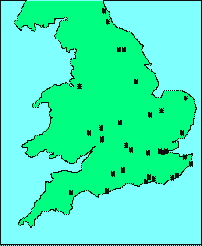
This map shows the number of Norman castles built during the reign of William the Conqueror (1066-1087)
“How to Build a 13th-Century Castle From Scratch”
For the full “History Unplugged” podcast, click here!
Medieval Castle: Within an Existing Roman Fortress
The earliest medieval castles built by the Normans were either constructed within an existing Roman Fort or were Motte and Bailey castles. These were soon replaced by Stone Keep castles as they offered better protection from attack. Concentric castles developed during the 12th and 13th Centuries and were virtually impossible to conquer.

Pevensey castle in East Sussex is an example of a Norman Castle built inside an existing Roman Fort.

Medieval Castle: Motte and Bailey Castles
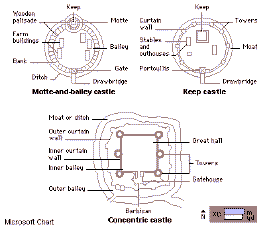
Motte and Bailiey castles were the earliest form of medieval castles built completely from scratch by the Normans. As their name suggests they had two parts the Motte and the Bailey.
The Motte was a large hill made of earth on which was built a wooden keep or lookout. The outer edge was then surrounded with a large wooden fence called a palisade.
The Bailey was separated from the Motte by a wooden bridge that could be removed if the Bailey was occupied by enemies. The Bailey was the part of the castle where people lived and animals were kept. A large castle might have more than one Bailey.
To give added protection to the castle, both the Motte and Bailey would be surrounded by a ditch, sometimes filled with water. A drawbridge was used for access to the castle.

Stone Keep Castle
This type of medieval castle soon replaced the Motte and Bailey castles as it offered a better form of defence. A stone keep was the central feature, with thick walls and few windows. Entrance to the keep was by stone steps leading to the first floor. The kitchens were situated on the ground floor while living quarters were on the upper floors.
The first keeps were rectangular in shape but later ones were often circular. The Stone Keep would be surrounded by a thick stone wall containing turrets for lookouts.
The Bailey was now the area outside the keep but within the outer walls and shelter for animals or craft workshops might be built against the walls. The entire castle might be surrounded by a ditch or moat and entrance to the castle was by drawbridge.

Concentric Castles
The Concentric castle was developed in the 12th and 13th Centuries and offered the best protection against attack.
The main feature of the concentric medieval castle is its walls. An inner wall built of thick stone with turrets positioned at intervals is then surrounded by an equally thick but lower stone wall. The walls are built at different levels so that archers on the inner walls can fire over the archers on the outer walls.
The space between the two walls was known as the ‘death hole’ for being trapped within the walls would almost certainly result in death for the attacker. The entire castle was then often surrounded with a moat and entry would be across a drawbridge.
This article is part of our larger selection of posts about the medieval period. To learn more, click here for our comprehensive guide to the Middle Ages.
This article is also part of our larger selection of posts about Medieval Life. To learn more, click here for our comprehensive guide to Medieval Life.
Additional Resources About Medieval Life


Cite This Article
"The Medieval Castle: Four Different Types" History on the Net© 2000-2024, Salem Media.
July 17, 2024 <https://www.historyonthenet.com/medieval-castle>
More Citation Information.