



Medieval punishment is a frequent topic of discussion among those who are interested in that particular time period.
Medievalists.net
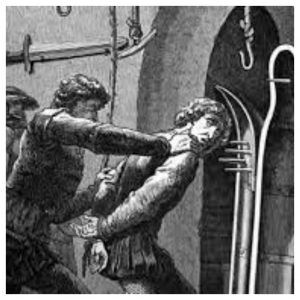
Throughout the medieval period, it was believed that the only way to keep order was to make sure that the people were scared of the punishments given for crimes committed. For this reason, all crimes from stealing to burglary of houses to murder had harsh medieval punishments.
Although there were gaols, they were generally used to hold a prisoner awaiting trial rather than as a means of punishment. Fines, shaming (being placed in stocks), mutilation (cutting off a part of the body), or death were the most common forms of medieval punishment.
There was no police force in the medieval period so law-enforcement was in the hands of the community.
“Medieval Punishment and Court”
Listen to the full “History Unplugged” podcast here!
The Manorial Court (Trial by Jury)
The manorial court dealt with all but the most serious crimes. It was held at various intervals during the year, and all villagers had to attend or pay a fine. All men were placed in groups of ten called a “tithing”. Each tithing had to make sure that no member of their group broke the law. If a member of a tithing broke a law then the other members had to make sure that he went to court.
The Lord’s steward was in charge of the court. A jury of twelve men was chosen by the villagers. The jury had to collect evidence and decide whether the accused was guilty or not guilty and, if found guilty, what the medieval punishment should be.
The King’s Court (Trial by Ordeal)
Serious crimes were heard by the King’s court. The accused had to face trial by ordeal to decide whether they were guilty or not guilty.
Medieval Punishment: Ordeal by Fire
The accused had to pick up a red hot iron bar and hold it while they walked three or four paces. Their hand was then bandaged. After three days they had to return to the court where the bandages were removed. If the wound was beginning to heal they were innocent but if the wound showed no sign of healing then they were pronounced Guilty.
This was likely the most horrifying use of medieval punishment.
Medieval Punishment: Ordeal by Water
The accused had their hands and feet tied together. They were then thrown into water. If they floated they were guilty but if they sank they were innocent.
Medieval Punishment: Ordeal by Combat
Noblemen would fight (usually to the death) in combat with their accusers. The winner of the battle would be considered to be in the right.
After 1215 Trial by Ordeal was replaced by Trial by Jury.
So, medieval punishment had to go through a number of processes. From the Manorial court to the King’s court.
This article on medieval punishment is part of our larger selection of posts about the medieval period. To learn more, click here for our comprehensive guide to the Middle Ages.
This article is also part of our larger selection of posts about Medieval Life. To learn more, click here for our comprehensive guide to Medieval Life.
Additional Resources About Medieval Life


Cite This Article
"Medieval Punishment: Crimes and Torture" History on the Net© 2000-2024, Salem Media.
April 24, 2024 <https://www.historyonthenet.com/medieval-life-crime-and-medieval-punishment>
More Citation Information.


