



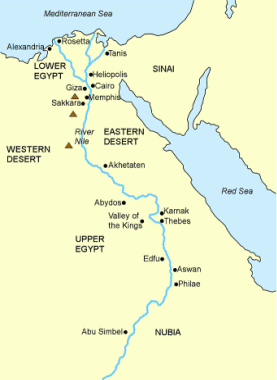
Egyptian farming was the bedrock of the ancient civilization, far more important than symbolic feats such as constructing massive pyramids. One of the reasons why the Ancient Egyptian civilization was so successful was the fact that they were able to farm the fertile soil around the Nile and produce their own food and cloth. The river Nile is the longest river in the World. The source of the river is in Burundi in Central Africa, it then flows through Sudan, Ethiopia and Egypt and empties into the Mediterranean sea.
During the early summer months the mountain region of Ethiopia experiences periods of heavy monsoon rainfall which increase the water level of the Nile causing it to flood in Egypt between June and September. The Egyptians call this the inundation. In 1889 work began on a dam to prevent the annual flood. The first Aswan dam was opened in 1902 but it proved to be insufficient and had to be raised twice in 1907–1912 and 1929–1933. In 1960 work began on a second dam, the Aswan High Dam which, since its opening in 1970 has prevented further floods.
The Egyptian Farming Year
The Inundation (Akhet) June to September

When the river Nile flooded, water, mud and silt from the river was washed up over the river banks creating a fertile growing area. During the period of the flood the Egyptian farmers spent time mending and making tools and looking after the animals. Many farmers also worked for the pharaoh during this time building pyramids and temples.
Growing (Peret) October to February

As soon as the flood began to recede the Ancient Egyptians ploughed the soil ready for sowing. They had hand ploughs or larger ones that were pulled by oxen.
Seeds were then sown into the newly ploughed soil. Goats and other animals then walked over the fields to push the seeds into the ground.
Crops grown included wheat, barley, flax, onions, leeks, garlic, beans, lettuce, lentils, cabbages, radishes, turnips, grapes, figs, plums and melons.
Harvest (Shemu) March to May

Grain was cut using a sickle. The cut grain was then tied into bundles and carried away.
Wheat was made into bread, barley was made into beer and flax was made into linen cloth.
Papyrus reeds that grew naturally along the banks of the Nile were used to make sandals, boats, baskets, mats and paper.
Fruit and vegetables were harvested when they ripened.
Cattle, goats, sheep, pigs, ducks, goats, and oxen were raised by farmers for their meat, milk, hides and also to help with Egyptian farming.
This article is part of our larger selection of posts about Ancient Egypt. To learn more, click here for our comprehensive guide to Ancient Egypt.
Additional Resources About The Egyptians


Cite This Article
"Egyptian Farming: Agriculture in the Old, Middle, and New Kingdoms" History on the Net© 2000-2024, Salem Media.
April 24, 2024 <https://www.historyonthenet.com/egyptian-farming>
More Citation Information.


